
How it works
A flexible collection model, based on direct checks, standard protocols and extensible controls.
Every technology queried in the most suitable way
Core runs periodic checks whose frequency and parameters are both configurable. An HTTP service can be queried directly with its native protocol, a Linux server via SSH, a device can expose metrics and states through SNMP, and a Windows system can be queried via WMI.
When local or specialised checks are needed, agents, scripts and plug-ins are used.
| Method | Operational use |
|---|---|
| Direct check | Verification of the service through its own protocol, for example HTTP or SMTP. |
| SSH | Remote execution of checks on systems reachable via Secure Shell. |
| SNMP | Reading metrics and states from devices, UPSs, sensors and compatible equipment. |
| WMI | Collection of information from Windows systems. |
| Agents and scripts | Local checks and specialised verifications, with results returned to Core. |
| Plug-in / NRPE | Extended execution of checks and integration of specialised verifications. |
The Sentinet³ subsystems
A subsystem-based architecture: data collection, in-memory processing, correlation and presentation are separate components working on the same state model.
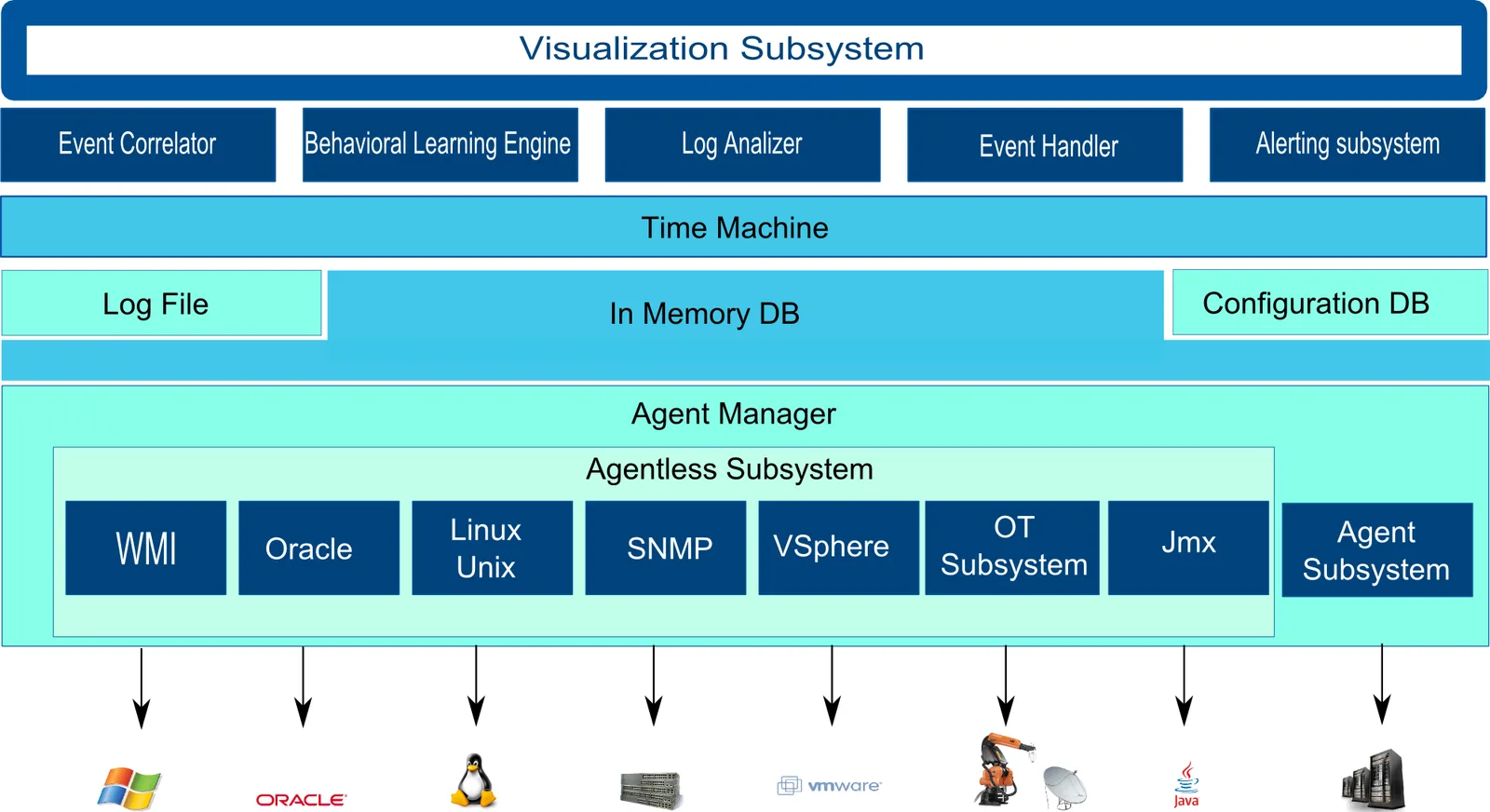
Visualization Subsystem
Presents states, maps, graphs and reports in the responsive web portal.
Correlation and learning
Event Correlator (event correlation and Root Cause Analysis), Behavioral Learning Engine, Event Handler for automatic actions and Alerting subsystem for notifications.
Time Machine
Keeps the history of states to take the infrastructure back to time X on day Y.
In Memory DB and Configuration DB
In-memory processing of states and a repository for the configuration of hosts, services and checks.
Agent Manager and agentless collection
Agentless subsystem with WMI, Oracle, Linux/Unix, SNMP, vSphere, JMX and OT Subsystem for industrial plants.
Agent Subsystem
Agents installed on systems for local and specialised checks.
Technology
- Responsive portal
- In-memory processing
- Integrates with third-party systems
- QR code integration
Fast configuration, without building every check from scratch
Patterns, or server recognition templates, associate a coordinated set of preconfigured checks with a host. The templates can include numerous parameters relating to the operating system, databases, applications and middleware.
Importing and exporting patterns makes it easy to reuse configurations across different installations.
- Choose the pattern suited to the technology or type of host.
- Select the checks you need from the preconfigured ones.
- Customise the parameters and activate the checks in the same operation.
- The pattern can be exported and reused in other installations.
Physical or virtual appliances, web interface
The platform can be deployed on physical or virtual appliances. The interface is web-based and does not require a dedicated console to be installed on operators’ workstations.
Checks are organised by host and service and feed graphs, dashboards, maps, historical analyses and notifications: the same collected data serves both day-to-day operations and analysis.
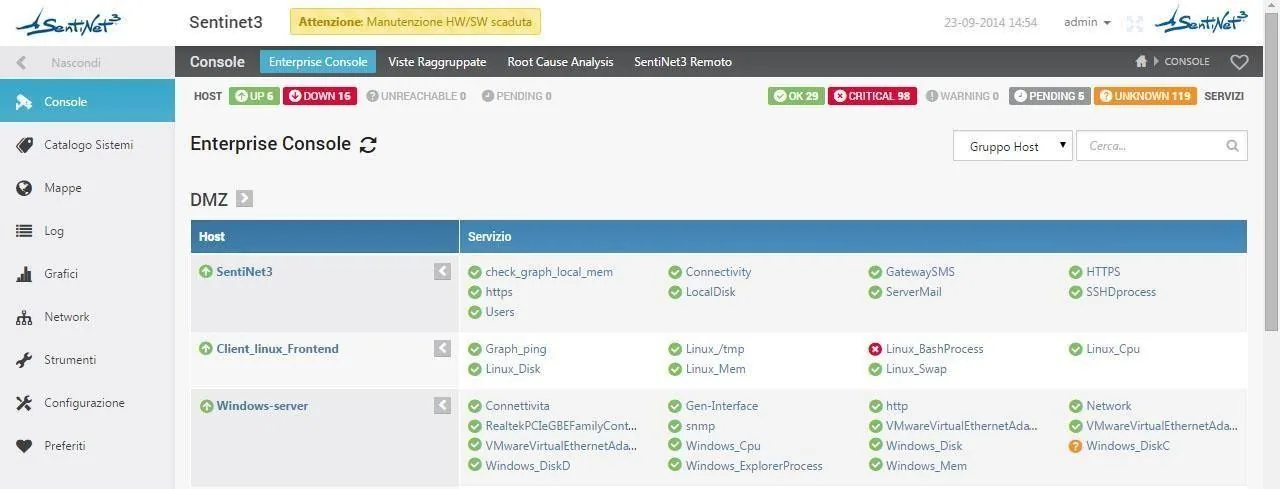
From check to views. Each check has its own execution frequency, parameters, thresholds, state and history. These elements populate the console and maps, Time Machine and the availability reports.
Hardware configurations and appliance sizes are described on the Appliances and deployment page.
A new service to bring under control
Autodiscovery detects a host and its available ports. A pattern associated with the technology quickly configures the checks, the console includes the new operational states and the device is added to the monitoring maps and reports. The process reduces the manual work needed to extend the monitoring scope.
All scenariosRelated topics
Want to see Sentinet³ on your infrastructure?
Tell us about your environment: sites, technologies, critical services. We will show you how Core and Infinity can work on your case.