
Microsoft Exchange Monitoring
Message queues, Mailbox server load, RPC mechanisms and OWA and ActiveSync clients under control with a single WMI-based package of checks.
Corporate email, from the big picture to the finest detail
Microsoft Exchange is one of the most widely used mail servers in companies, and its correct operation is essential to the business.
To keep it under control, Sentinet³ provides the Sentinet³ Exchange Pattern, a package of dedicated checks that relies on the native WMI (Windows Management Instrumentation) technology, developed by Microsoft for the remote management of data and applications in enterprise environments.
The Pattern watches the server’s essential parameters at a level of detail defined by the user: from the big picture, such as message queue size and server load, to the finest detail, such as data on individual transport protocols.
| At a glance | |
|---|---|
| Pattern | Sentinet³ Exchange Pattern |
| Collection technology | WMI |
| Sources | WMI counters of the Exchange server |
| Scope | Server, Hub Transport, Mailbox servers, RPC mechanisms, OWA and ActiveSync |
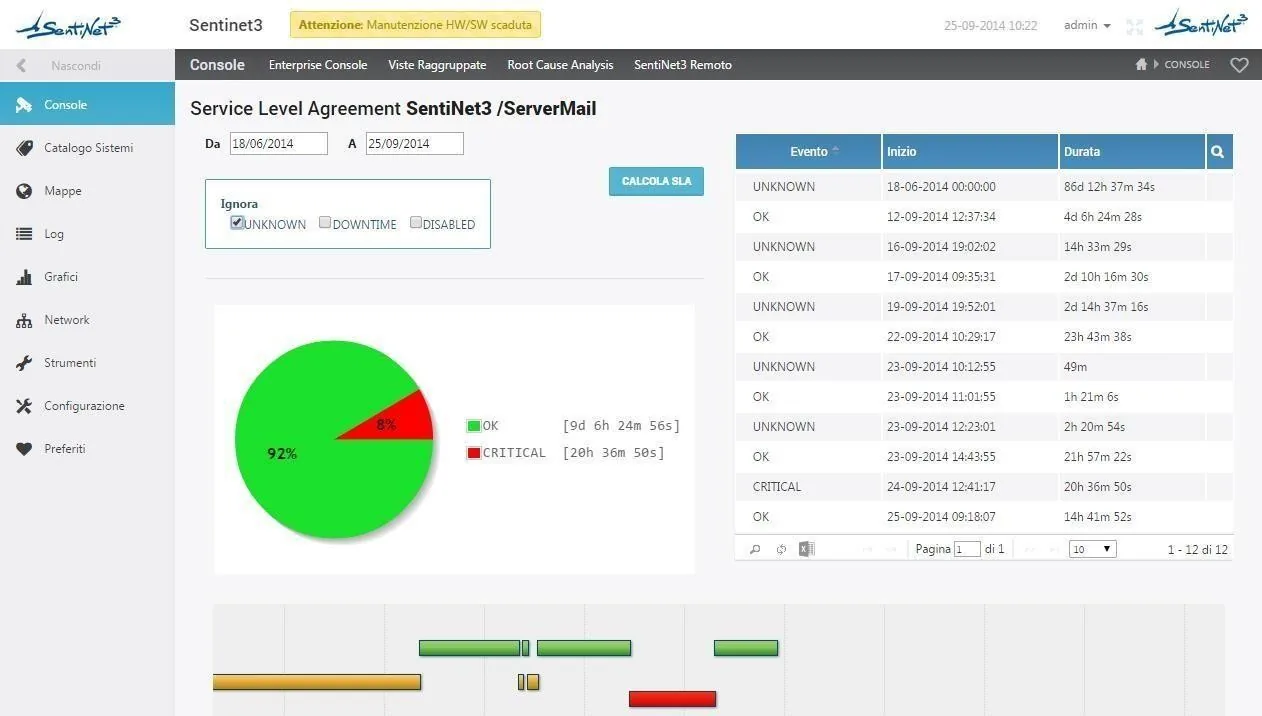
The Pattern’s checks
The checks are grouped as in the Pattern: server resources, queues, load, RPC and the main Exchange clients.
Server
| Check | What it verifies |
|---|---|
| Reachability | The server responds on the network |
| CPU | Percentage of CPU utilisation |
| Memory | Memory usage |
| Disk | Free disk space |
Hub Transport message queues
Size of all the message queues handled by the Hub Transport.
| Check | What it verifies |
|---|---|
| Total | Total messages retransmitted by the Hub Transport |
| SendQueue | Total messages sent by the Hub Transport |
Mailbox server load
| Check | What it verifies |
|---|---|
| Forwarded | Messages forwarded per second |
| Forwarded_Messages | Forwarded messages |
| Operations_RPC_sec | RPC operations per second |
| RpcSlowPacket | Slow RPC packets |
| ldap_ | Client activity: LDAP reads per second |
| Queued_Messages | Client activity: messages queued for delivery |
| Sent_Messages | Client activity: sent messages |
| Sent_Messages-sec | Client activity: messages sent per second |
| TotalMessagesSent | Client activity: total messages sent |
RPC mechanism congestion
RPC mechanisms are essential to the operation of the infrastructure.
| Check | What it verifies |
|---|---|
| RPC_Request | Number of RPC requests |
| Latency_RPC | Average latency of RPC calls |
OWA (Outlook Web Access) clients
| Check | What it verifies |
|---|---|
| OWA_SentMessages | Messages sent via OWA |
| OWA_ | Expired searches |
| OWA_ | Average search time |
| OWA_ | Average response time |
| OWA_ConnectedUsers | Connected users |
ActiveSync clients
| Check | What it verifies |
|---|---|
| ActiveSync_ | Average request time |
| Ping | ActiveSync Ping check |
A service the business cannot do without
- Email always available: the correct operation of the mail server is essential to the company’s activity.
- Level of detail of your choice: from queue size and server load down to data on individual transport protocols.
- RPC congestion highlighted: requests and average latency of the RPC mechanisms flag infrastructure slowdowns in good time.
- Clients under control: OWA and ActiveSync are monitored with response times, searches and connected users.
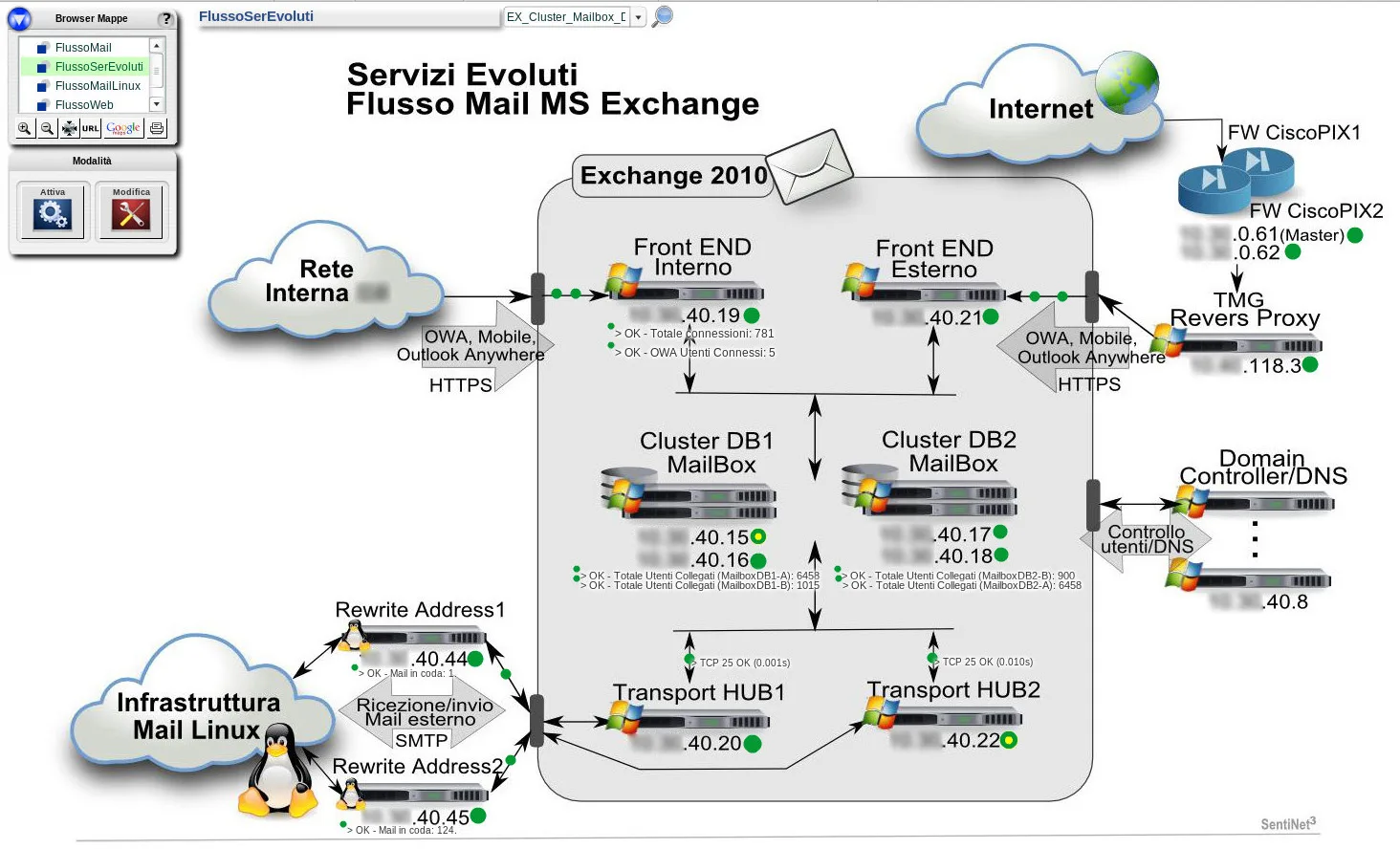
The status of the checks can also be shown on a logical map of the mail service, which displays at a glance the components involved and their connections.
Related topics
Want to see Sentinet³ on your infrastructure?
Tell us about your environment: sites, technologies, critical services. We will show you how Core and Infinity can work on your case.